


WHY DOES SOMETHING AS SIMPLE AS GHEE SUDDENLY HAVE A PERSONALITY NOW?
I’m serious.
At some point, ghee stopped being just… ghee. It became A2 ghee. Premium. Ancient. Almost spiritual if you read enough packaging labels.
And I remember standing in a grocery store aisle, holding two jars—one normal, one A2—and thinking, “Are you actually better… or just better at marketing?”
Spoiler: I bought the expensive one. Regret? Slightly. Curiosity? Absolutely.
So what even is A2 ghee? (and why is acting important?)
Alright, super simple version no lab coat required.
Milk has protein. That protein has types. The two main ones? A1 and A2 beta-casein. Sounds like something from a biology exam you forgot on purpose.
Most regular dairy (especially the mass-produced kind) has A1. Meanwhile, milk from certain traditional cow breeds carries A2.
Now here’s where it gets interesting—or confusing depending on your patience level—A2 ghee is made from that A2 milk.
That’s it.
No magic spell. No golden cow walking through Himalayan mist (although honestly, branding-wise, that would work).
My digestion story (aka: things I didn’t expect to notice)
Okay, tiny confession.
I never thought I had “issues” with dairy. Like, I wasn’t dramatically intolerant or anything. No chaos. No emergency situations.
But there was this… heaviness.
You know that feeling when you eat something and your body just goes, “hmm… I’ll deal with this later,” and then never fully deals with it?
Yeah, that.
When I switched to A2 ghee (not even intentionally—just experimenting), I noticed something weird: nothing happened.
And I mean that in a good way.
No bloating. No sluggish fog. Just… neutral.
Which, honestly, felt like an upgrade.
There’s some science floating around about A1 protein breaking into something called BCM-7—don’t worry about remembering that—and how it might mess with digestion for some people.
A2 doesn’t do that in the same way.
Do I fully understand the chemistry? Not even close.
Did my stomach seem happier? Kinda, yeah.
Nutrients… but let’s not make it boring
Here’s the part where most blogs go into textbook mode.
I’ll try not to.
A2 ghee has vitamins. Important ones. The kind your body quietly depends on while you’re busy scrolling your phone at 2AM.
We’re talking:
- Vitamin A (eyes, skin, all that glow stuff)
- Vitamin D (bones… and mood if we’re being honest)
- Vitamin E (antioxidant, fancy word, useful job)
- Vitamin K (the underrated one nobody talks about enough)
But here’s the thing nobody told me earlier—how it’s made matters more than the label sometimes.
There’s this traditional method called bilona. Sounds exotic, but it basically means they churn curd instead of just processing cream like a factory assembly line.
And weirdly? That old-school method actually seems to produce richer ghee.
So yeah… grandma might’ve been onto something. Again.
Immunity… but let’s not pretend it’s a superhero cape
Every health product claims this. Every single one.
“Boosts immunity!!!”
At this point, I read that and automatically roll my eyes a little.
But A2 ghee does have something called butyric acid—which, okay, sounds intense—but it’s actually helpful for your gut.
And your gut? It’s kind of the control center nobody respects enough.
Better gut = better immune response.
Not instantly. Not dramatically. But gradually… like watering a plant and not yelling at it to grow faster.
The heart health thing (yes, fat is confusing)
Let’s address the elephant sitting comfortably in butter.
Fat used to be the villain. Then suddenly carbs got blamed. Now everyone’s confused and just eating whatever their favorite influencer says.
Here’s the grounded take:
A2 ghee has saturated fats. That’s not new.
But in moderate amounts, and especially in less processed forms, these fats can actually support HDL (the “good” cholesterol).
Does that mean you should drown your food in ghee?
No. Please don’t.
I tried going heavy once—everything tasted amazing for about two days… then my body was like, “we need to talk.”
Balance still wins. Every time.
Skin and hair… the unexpected side quest
This part felt the most “Instagram myth” to me at first.
Like—eat ghee and suddenly your skin glows?
Sure.
But… something subtle did happen.
Not overnight. Not dramatically.
Just… less dryness.
My lips didn’t feel like cracked desert land during winter. My skin didn’t feel constantly annoyed.
It wasn’t a glow-up. It was more like… a quiet upgrade.
Which honestly feels more believable.
Lactose intolerance plot twist
Here’s something that surprised me more than it should’ve.
Ghee—especially well-made—has almost no lactose left.
So technically, even people who struggle with milk sometimes handle ghee just fine.
Not everyone. Bodies are unpredictable little chaos machines.
But still… it explains why some people swear by it even when dairy usually betrays them.
Ancient wisdom vs modern science
I love this part.
Because Ayurveda has been hyping ghee for centuries. Calling it nourishing, healing, almost sacred.
Meanwhile, modern science is like:
“Hmm… yes… fatty acids… gut microbiome… interesting…”
It’s like watching two completely different worlds slowly nod at each other.
Not always agreeing. But not arguing either.
And honestly? That overlap is kind of fascinating.
How I actually use it (no complicated routine, promise)
Let me keep this real.
I didn’t suddenly become that person with a 7-step morning ritual involving sunlight and chanting.
Here’s what I actually do:
- Add a small spoon to warm food
- Use it instead of oil sometimes
- Drizzle it on dal when I want comfort food energy
- Occasionally overdo it on parathas and pretend it’s “intentional”
That’s it.
Nothing aesthetic. Nothing Pinterest-worthy.
Just… normal usage.
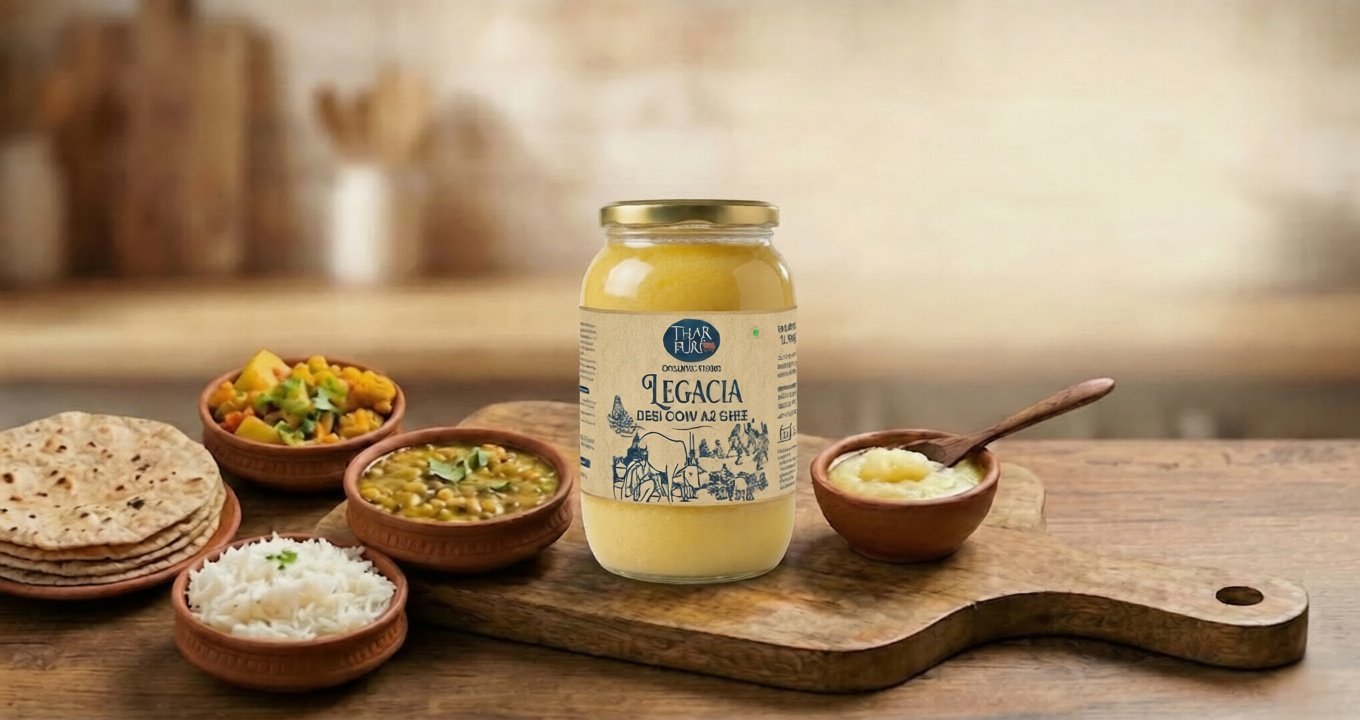
For those who value purity in dairy products, Tharpure provides authentic A2 cow ghee prepared using time-honored techniques.
The annoying truth: it’s expensive
Yeah, we need to talk about this.
A2 ghee costs more. Sometimes a lot more.
And not every brand selling “A2” is actually delivering quality.
Some are just… really good at packaging.
So if you’re buying:
- Look for traditional methods
- Check sourcing (grass-fed if possible)
- Avoid anything that feels overly commercialized
Because paying more for average quality? That stings.
So… is it actually worth it?
Here’s the honest, no-BS answer.
It depends.
If your diet is already decent and you care about small upgrades—yeah, A2 ghee might be a nice addition.
If everything else is chaos (junk food, no sleep, stress eating), this won’t magically fix anything.
It’s not a miracle.
It’s more like… a supporting character that quietly does its job.
Final thought (and this one matters)
I started this whole thing thinking I’d either fully believe in A2 ghee or completely dismiss it.
But I landed somewhere in the middle.
Which feels… more human, honestly.
It’s helpful. Not magical. Better in some ways. Not essential for everyone.
And maybe that’s the real takeaway here:
Not everything needs to be extreme to be useful.
Sometimes the smallest changes—the kind you barely notice at first—end up being the ones that actually stick.
